Looking for the right cookware partner? Tell us about your product ideas, target market, materials, and order needs. Our team can help you explore sourcing options, OEM and ODM development, quality requirements, and practical next steps. Share your project details to start a conversation and receive a clear, tailored response for your next project.
For a private-label cooking equipment brand, the cheapest frying pan to make is not necessarily the cheapest product to sell.
Two stainless steel pots and pans collections can look almost the same in item pictures while varying significantly in internal construction, heating behavior, making resistances, and long-lasting dependability. A sleek coating and persuading product description expose little about how a frying pan will execute after months of everyday usage.
Tri-ply stainless steel kitchenware and impact-bonded base kitchenware address the very same standard engineering issue in different ways: combining stainless-steel with conductive products that disperse warmth throughout cooking.
The difference matters readily. It affects producing costs, item positioning, quality-control demands, and the cases a brand name can fairly make.
My setting is uncomplicated: neither building is automatically remarkable for every private-label program. The ideal selection depends upon intended use, target list price, product requirements, manufacturing facility abilities, and proof from finished-product screening.
What Is the Distinction Between Tri-Ply and Impact-Bonded Pots And Pans?
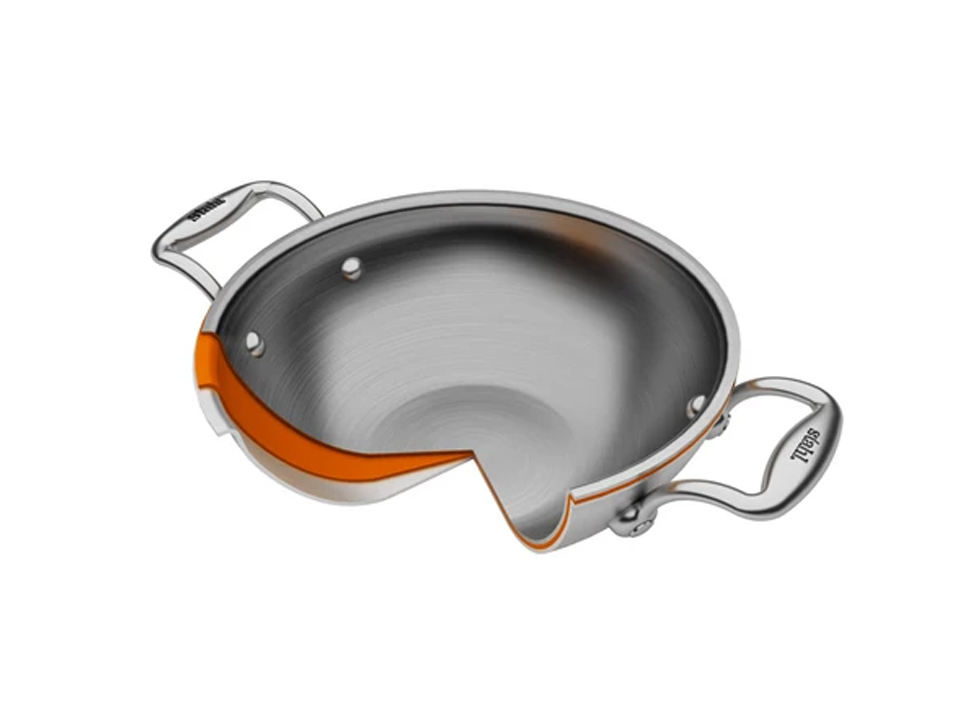
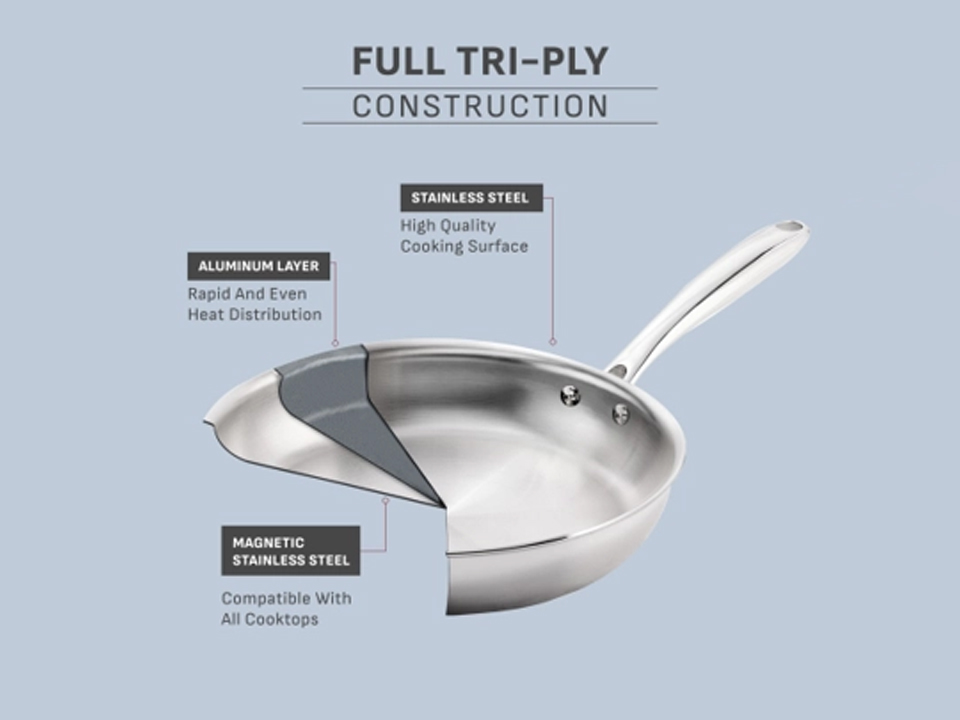
Tri-ply kitchenware generally uses 3 bonded steel layers extending via the base and sidewalls. A common arrangement places a light weight aluminum conductive core between internal and outer stainless-steel layers.
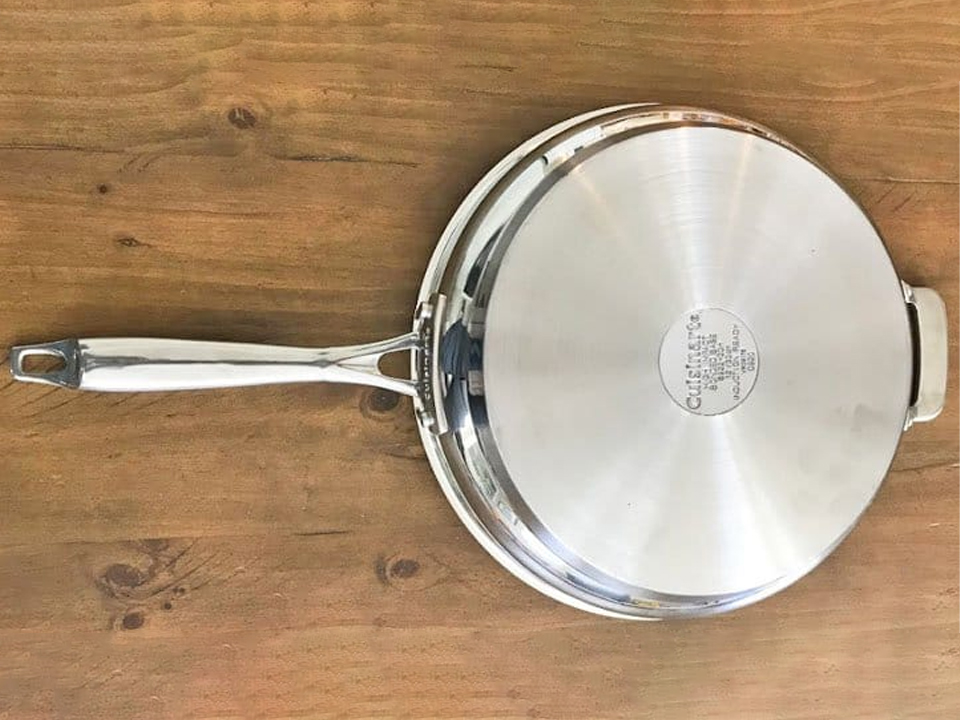
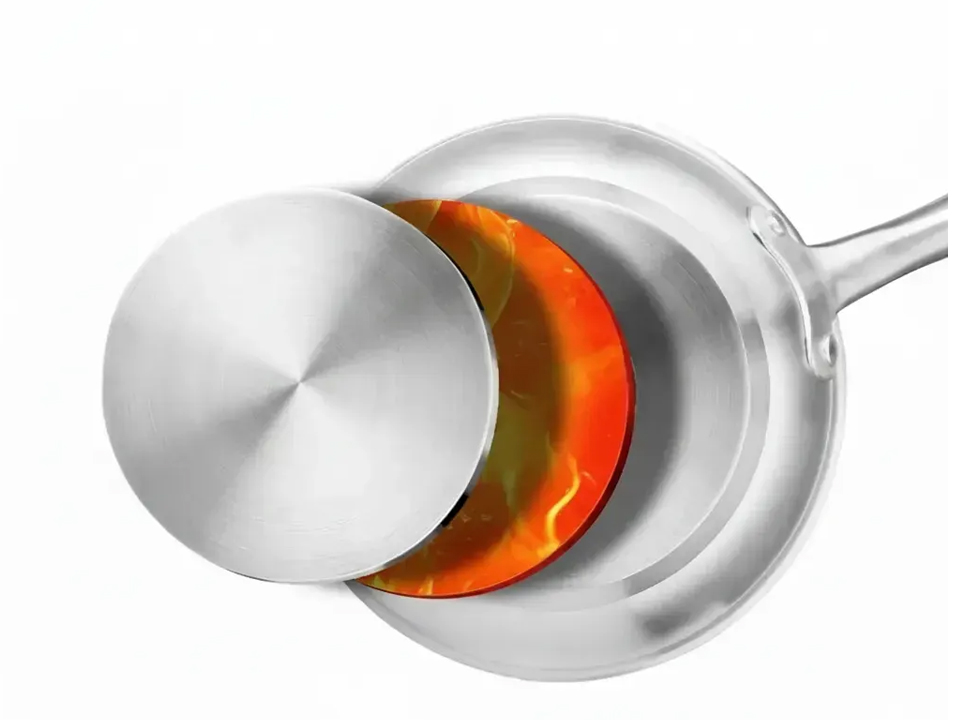
Impact-bonded cooking equipment generally consists of a stainless-steel vessel with a different multilayer conductive disc affixed to its base. The conductive framework is concentrated mostly in the base as opposed to expanding constantly through the sidewalls.
This transforms just how warmth spreads through the vessel.
Tri-ply building can give more extensive heat circulation across the base and sidewalls. Impact-bonded building and construction can deliver reliable base home heating while providing makers a potentially a lot more cost-effective manufacturing technique.
Neither design assurances exceptional efficiency. Product grades, core density, base size, vessel geometry, bonding quality, and making consistency all influence the outcome.
Just How Tri-Ply Stainless-steel Kitchenware Is Constructed
A normal tri-ply vessel incorporates a stainless-steel cooking surface, an aluminum core, and an outside stainless-steel layer. Specific materials and thicknesses vary by manufacturer.
Its main advantage is the constant conductive framework. Due to the fact that the core extends up the sidewalls, tri-ply cooking equipment can disperse heat beyond the central food preparation surface.
This might benefit:
Sauces that need controlled home heating.
Sautéing across a bigger cooking surface.
Cooking tasks entailing ingredients that move around the frying pan.
Premium line of product stressing building and convenience.
Yet tri-ply is not unsusceptible to manufacturing flaws. Irregular density, distortion, bad bonding, and poor ending up can undermine its expected advantages.
Customers should for that reason review real construction and production consistency rather than paying a costs just for the word tri-ply.
How Impact-Bonded Base Cooking Equipment Is Constructed
Impact-bonded pots and pans generally utilizes an individually created stainless steel vessel with a conductive base disc attached to its underside. The disc generally includes a light weight aluminum core between stainless steel layers, although styles vary.
This method can be eye-catching for high-volume private-label programs since makers might use established vessel-forming processes and connect ideal base settings up throughout manufacturing.
Possible applications include:
Entry-level and mid-market pots and pans sets.
Stockpots and pans used primarily for boiling and simmering.
Price-sensitive retail programs.
Promotional cookware varieties.
The principal compromise is that the sidewalls normally lack the exact same continuous conductive core located in full-clad tri-ply building and construction.
Still, a well-designed impact-bonded frying pan can be a sensible business option. Purchasers should confirm base monotony, disc add-on, material specs, and compatibility with the designated cooktop.
Full-Clad vs Encapsulated-Bottom Cookware: Understanding the Terms
Full-clad usually explains layered building and construction extending with the base and sidewalls. Tri-ply generally refers to a three-layer plan, although buyers should confirm the actual materials and framework.
Impact-bonded defines an approach of affixing a base setting up to a vessel. Encapsulated-bottom kitchenware generally describes a conductive disc included right into a stainless steel base framework.
The terms may overlap in vendor advertising, so terms alone can not develop the exact building.
This produces an usual sourcing threat: 2 manufacturing facilities may quote items using similar summaries while supplying materially different designs.
Ask for the adhering to prior to contrasting quotations:
Cross-sectional building and construction drawings.
Stainless steel grades and conductive-core materials.
Nominal base and wall surface thicknesses.
Base-disc dimensions and attachment specs.
Written confirmation of where the conductive core extends.
If a distributor can not plainly discuss what is inside the pan, the product is not properly specified for a regulated private-label program.
Why Layer Matter Does Not Verify Top quality
3 layers do not automatically outperform two, and five layers do not instantly outperform 3.
Performance depends upon the materials, density distribution, geometry, and bonding quality. A slim conductive core can restrict warm spreading even when the item brings a premium building claim.
Similarly, better weight does not automatically mean much better kitchenware. Added mass impacts warmth retention, managing, shipping weight, and price.
Consider 2 hypothetical pans: one has a small general density of 2.0 mm, while an additional makes use of a different density and layer setup. The complete dimension alone does not disclose the density of each layer or the resulting food preparation efficiency.
The exact same applies to impact-bonded bases. Disc size alone does not establish core thickness, bonding stability, or monotony.
My suggestion is to treat construction insurance claims as hypotheses to verify, not evidence of quality.
Tri-Ply vs Impact-Bonded Cooking Equipment: Contrast Table
The adhering to contrast describes normal building tendencies, not guaranteed outcomes for every single item.
Factor
Tri-ply stainless-steel
Impact-bonded base
Conductive framework
Generally expands with base and sidewalls
Concentrated primarily in base
Sidewall home heating
Usually more extensive
Generally a lot more minimal
Manufacturing technique
Split product formed into vessel
Separate base setting up connected to vessel
Loved one production price
Usually greater
Frequently lower for equivalent mass-market styles
Weight
Depend upon products and thickness
Depend upon vessel and base style
Normal positioning
Mid-to-premium varieties
Worth and conventional arrays
Main top quality checks
Layer consistency, density, monotony, coating
Disc attachment, flatness, measurements, finish
Induction compatibility
Rely on magnetic exterior base and design
Depends on magnetic base materials and layout
Finest acquiring proof
Construction specs and performance tests
Base specs, attachment checks, efficiency examinations
Building and construction is just one variable. An inadequately developed tri-ply pan may execute even worse in a particular application than a well-designed impact-bonded version.
Purchasers must use the table to identify what requires testing, not as a replacement for screening.
Which Building And Construction Distributes Heat Extra Equally?
Tri-ply typically supplies extra substantial warmth circulation with the base and sidewalls since its conductive core extends farther up the vessel. Impact-bonded pots and pans focuses its conductive framework primarily in the bottom.
But what does “more uniformly” mean?
A purchaser might be worried concerning temperature distinctions in between the facility and side of the base, local hot spots, or temperature level variant in between the base and sidewalls. These belong however distinct efficiency actions.
A practical contrast must use the same heater, starting temperature level, liquid amount, heating duration, and dimension approach. Document temperature levels at fixed points and repeat the examination to determine variation.
For pans, a regulated water-heating test can supply useful comparative data. For sauté pans, testing should check out temperature circulation throughout the cooking surface area under representative problems.
The designated application issues. A stockpot used primarily for boiling water might not require the same sidewall efficiency as a pan developed for delicate sauces or sautéing.
For private-label customers, this recommends a far better technique than picking one building for each SKU: match the style to the cooking job and target customer.
Is Tri-Ply Well Worth the Additional Expense?
Sometimes. However the costs must support a commercial benefit.
Tri-ply might validate additional cost when consumers value building, convenience, and costs positioning. Nonetheless, the decision must represent the complete economics instead of manufacturing facility price alone.
These numbers are hypothetical, not validated market prices.
The tri-ply alternative makes good sense just if the added expense supports the intended business case. That may suggest a greater attainable market price, boosted product differentiation, or verifiable renovations in customer complete satisfaction.
Buyers must determine landed cost, including products, applicable responsibilities, packaging, examination, warehousing, circulation margins, and possible returns.
They ought to likewise model conventional, expected, and hopeful sales situations as opposed to thinking consumers will certainly pay more because the product has 3 layers.
Hidden Costs Customers Commonly Miss
Spec intricacy: Numerous constructions, finishes, and element mixes can enhance tasting, assessment, and production-coordination prices.
Delivering and managing: Product weight and container measurements affect logistics costs and storehouse efficiency.
Quality-related costs: Returns, replacement shipments, and client issues can deteriorate financial savings from a reduced factory cost.
Weak item distinction: An extra costly building and construction might use little industrial worth if clients can not view a significant benefit.
The goal is not to purchase one of the most innovative frying pan available. It is to buy the construction that produces the strongest balance of performance, integrity, and complete price.
Just How Private-Label Purchasers Should Examine Cookware Manufacturers
A manufacturing facility efficient in producing cooking equipment is not necessarily efficient in delivering constant private-label manufacturing.
Examples might get uncommonly mindful attention. Automation introduces irregularity in products, forming, joining, completing, assembly, and packaging.
I would certainly evaluate producers versus five demands.
1. Material Traceability
Request stainless-steel qualities, conductive-core materials, density requirements, and appropriate product documents.
Establish how the factory attaches these documents to real production batches and stops unauthorized material replacements.
“Food-grade stainless-steel” is not a full requirements. Customers need to identify the real material and establish which compliance requirements apply to the completed item.
2. Construction Illustrations and Accepted Samples
Obtain a cross-sectional illustration and a created item spec. For impact-bonded models, document base-disc measurements and add-on requirements.
Authorize a production-representative sample and link it to a revision-controlled requirements. Modifications to materials, thickness, tooling, or construction needs to need written authorization.
Or else, subsequent orders might differ from the sample originally accepted.
3. Performance Testing
Define pertinent examinations before choosing a distributor. Depending on the product, these might include temperature level distribution, heating behavior, base monotony, and compatibility with the designated food preparation devices.
Use consistent techniques throughout suppliers and keep the outcomes.
One successful demonstration does not develop production consistency.
4. Mechanical and Dimensional Quality
Check vessel geometry, deal with add-on, cover fit, rim finish, and surface high quality.
For impact-bonded kitchenware, define acceptable base-attachment and monotony criteria. For tri-ply pots and pans, confirm layer building and density against the accepted specification.
The purpose is to change vague expectations with quantifiable acceptance demands.
5. Production Consistency
Ask exactly how the maker regulates inbound materials, in-process inspections, final-product approval, and rehabilitative actions.
For a brand-new program, consider a pilot production run before dedicating to a larger order. Agree on flaw categories, tasting procedures, and the process for handling nonconforming products.
A private-label purchaser is buying more than a sample. The customer is acquiring repeatable production under a concurred requirements.
Quality Assurance and Regulatory Danger
Cookware can appear appropriate during an aesthetic evaluation yet fall short various other demands. Base distortion, inconsistent building, weak accessories, and unproven products are reasons to develop a documented quality-control procedure.
Regulatory compliance should have separate interest.
This warning does not establish that tri-ply stainless-steel cookware or impact-bonded stainless-steel pots and pans inherently presents the very same hazard. It shows why material confirmation and suitable food-contact security assessments matter.
For private-label programs, customers must:
Verify the actual products used.
Identify appropriate food-contact requirements in each target market.
Acquire appropriate test reports and supporting documents.
Keep set traceability and change-control treatments.
A distributor’s common assurance that a product is “FDA approved” should not replace confirmation of the relevant needs and proof.
Quality assurance is not management overhead. It becomes part of protecting the brand.
OEM/ODM Stainless Steel Cookware: What Customers Need To Discuss
OEM and ODM setups vary in layout obligation, tooling, and personalization. The tags alone do not establish who has a design or who approves manufacturing changes.
A private-label agreement should specify:
Approved building and construction, materials, and reference examples.
Minimum order quantities and permitted tolerances.
Product packaging and art work requirements.
Evaluation procedures and flaw approval criteria.
Examining and compliance-documentation responsibilities.
Ownership and use tooling and custom-made layouts.
Treatments for remedying issues and authorizing adjustments.
These demands become specifically important when the exact same manufacturing facility generates similar pots and pans for multiple consumers.
If a conflict emerges over product substitutions or base monotony, generic product descriptions provide little security. A clear specification produces a predetermined recommendation for production and assessment.
Tri-Ply Pots And Pans Wholesale Sourcing: Building the Right Variety
Cookware sets show why building choices need to be made at the part level.
A 10-piece collection may contain numerous casseroles, saucepans, and covers. A 12-piece collection might consist of a frying pan or added vessel dimensions. The exact composition differs, and the private pieces do not necessarily share identical construction.
The complying with product referrals can sustain selection research:
10-piece silver-tone covered dish pots and pans set for wholesale
10-piece silver-tone pots and pans established for wholesale distributors
10-piece stainless-steel cookware set from a wholesale provider
12-piece lidded cookware set with frying pan for wholesale
These links are variety references, not validated evidence that the detailed items use a certain construction. Purchasers need to confirm each product’s materials, measurements, and performance requirements straight.
A component-level specification should identify the intended building and construction of each vessel, take care of and lid demands, and suitable inspection criteria.
A brand name could sensibly select impact-bonded construction for some items and tri-ply for others. What matters is that those differences offer a clear objective and continue to be constant throughout production.
How to Pick Tri-Ply or Impact-Bonded Kitchenware for Private-Label Programs
Use a recorded decision procedure:
Define the target consumer. Establish the list price, distribution channel, and designated food preparation jobs.
Specify the item. Videotape materials, thicknesses, measurements, coating, and construction.
Contrast equivalent quotations. Determine building and construction distinctions instead of hiding them inside a general product summary.
Examination representative examples. Apply consistent techniques and predefined acceptance standards.
Validate conformity. Develop applicable food-contact and product-safety requirements.
Compute overall expense. Include logistics, assessment, packaging, and possible quality-related expenses.
Control production. Accept the final specification and need permission for adjustments.
This procedure can not get rid of every sourcing risk, but it minimizes the opportunity that an advertising case or insufficient quote determines the decision.
Regularly Asked Concerns
Is tri-ply stainless steel kitchenware far better than impact-bonded cooking equipment?
Tri-ply stainless-steel pots and pans generally provides extra considerable warmth distribution through the base and sidewalls because its conductive core expands through even more of the vessel. Impact-bonded cooking equipment focuses its conductive structure mainly in the base, making it suitable for several daily cooking tasks. Neither building and construction is globally much better; efficiency depends upon materials, design, producing high quality, and intended usage.
For private-label programs, tri-ply might suit costs products where sidewall home heating matters. Impact-bonded pots and pans might be suitable for price-sensitive ranges when testing verifies adequate performance.
What is the distinction in between full-clad and impact-bonded cooking equipment?
Full-clad kitchenware typically uses bonded metal layers expanding through the base and sidewalls, whereas impact-bonded pots and pans typically has a different conductive disc connected to the bottom of a stainless steel vessel. Full-clad construction supplies an extra constant conductive framework, while impact-bonded designs concentrate heat-transfer products in the base.
Because vendor terms can vary, customers must ask for construction illustrations and material specifications before contrasting quotes.
Is impact-bonded base cookware ideal for private-label programs?
Impact-bonded base cooking equipment utilizes a conductive setting up attached to a stainless-steel vessel, using a potential balance in between day-to-day cooking performance and manufacturing expense. It can suit value-oriented and traditional private-label collections when the finished item meets the necessary efficiency, resilience, and quality specifications.
Buyers must confirm base flatness, material specifications, accessory quality, and compatibility with the desired cooktop.
Does tri-ply cooking equipment always cost even more?
Tri-ply kitchenware uses numerous adhered layers via the base and sidewalls and commonly costs even more to produce than equivalent impact-bonded styles. Actual prices depend on products, density, vessel size, manufacturing quantity, finishing, and factory abilities.
Compare equivalent specs and landed prices rather than assuming that every tri-ply item carries the exact same premium.
Exactly how can customers verify tri-ply kitchenware top quality?
Tri-ply cookware high quality is evaluated through verification of its split construction, material grades, densities, bonding stability, dimensional resistances, surface area finish, and pertinent efficiency outcomes. A layer-count claim alone can not develop quality because product selection and production consistency impact the ended up item.
Demand illustrations, product documents, approved samples, and examination outcomes. Establish written approval standards prior to mass production.
Is impact-bonded cooking equipment compatible with induction cooktops?
Induction-compatible impact-bonded kitchenware has a base having suitable magnetic product and a design that satisfies the demands of the designated induction devices. Compatibility relies on the real base products and building and construction, not on the term impact-bonded alone.
Ask the vendor to determine the outside base product and give appropriate compatibility examination outcomes.
What should customers ask impact-bonded cooking equipment distributors?
Impact-bonded pots and pans vendors ought to have the ability to record the base-disc construction, product grades, core dimensions, attachment process, dimensional resistances, and quality-control procedures. Purchasers must likewise agree on approved examples, testing obligations, packaging demands, and defect-handling treatments.
Created specs aid guarantee that provided products match the agreed needs across repeat orders.
Just how should a private-label brand choose the most effective pots and pans building?
The very best cookware building is the one that meets the brand name’s desired cooking-performance needs, retail positioning, quality standards, and total-cost purposes. Tri-ply may suit products where continual sidewall heating and premium placing matter, while impact-bonded cookware may work well for value-oriented varieties calling for effective base home heating.
Specify the target client, contrast recorded requirements, test examples, validate conformity, and determine landed price prior to accepting manufacturing.
Last Suggestion: Acquire the Performance You Can Validate
Tri-ply and impact-bonded kitchenware make use of different buildings to achieve sensible cooking efficiency. Tri-ply typically supplies a more continuous conductive structure, while impact-bonded kitchenware can offer effective base heating with a possibly a lot more economical manufacturing method.
Neither ought to be picked only because of a premium tag or a reduced quotation.
For private-label brand names, the greatest decision lines up building with the desired food preparation jobs, consumer expectations, list price, and documented quality requirements.
If tri-ply provides a quantifiable benefit that sustains the item’s positioning, the additional expenditure may be warranted. If impact-bonded building satisfies the required criteria at a more suitable complete price, choosing it is not a concession.
Prior to authorizing mass production, request building and construction drawings, material requirements, sample-testing outcomes, and comparable quotations. Those records offer a more powerful basis for purchasing decisions than layer-count insurance claims or polished product photographs.