Looking for the right cookware partner? Tell us about your product ideas, target market, materials, and order needs. Our team can help you explore sourcing options, OEM and ODM development, quality requirements, and practical next steps. Share your project details to start a conversation and receive a clear, tailored response for your next project.
When sourcing private-label cookware, the rate a factory quotes is just one component of the commercial choice. Product qualities, body density, base construction, handle attachment, packaging, inspection standards, and delivery terms can all change the last price.
So, what are you comparing when 3 factories price estimate different prices for an evidently similar pots and pans established?
Commonly, you are not comparing the same items whatsoever.
An ask for quotation (RFQ) must call for distributors to price the very same defined item, divulge their presumptions, and recognize variances prior to settlements begin. The objective is simple: make the item measurable, the price equivalent, and the distributor accountable.
What Is a Personal Tag Kitchenware RFQ?
A personal label cookware RFQ is an official investing in document that defines the item a purchaser desires made under its very own brand and demands detailed pricing, technological requirements, quality requirements, compliance paperwork, and delivery terms.
A total RFQ normally includes:
Item definition: Set arrangement, measurements, capabilities, and SKUs.
Products: Stainless steel qualities, aluminum building, and finish specifications.
Production: Body density, base design, deals with, lids, and surface coatings.
Quality assurance: Evaluation requirements, screening approaches, and issue categories.
Business terms: MOQ, device rates, tooling, product packaging, and repayment problems.
Shipment: Manufacturing lead time, Incoterms, and delivery needs.
Conformity: Relevant food-contact guidelines and supporting paperwork.
If a requirement can influence product performance, safety, cost, or retail presentation, do not leave it as an undocumented presumption.
Why Most Pots And Pans RFQs Generate Misguiding Quotes
The issue is hardly ever that suppliers can not compute prices. Buyers often ask numerous manufacturing facilities to price estimate an undefined product and then treat the numbers as straight equivalent.
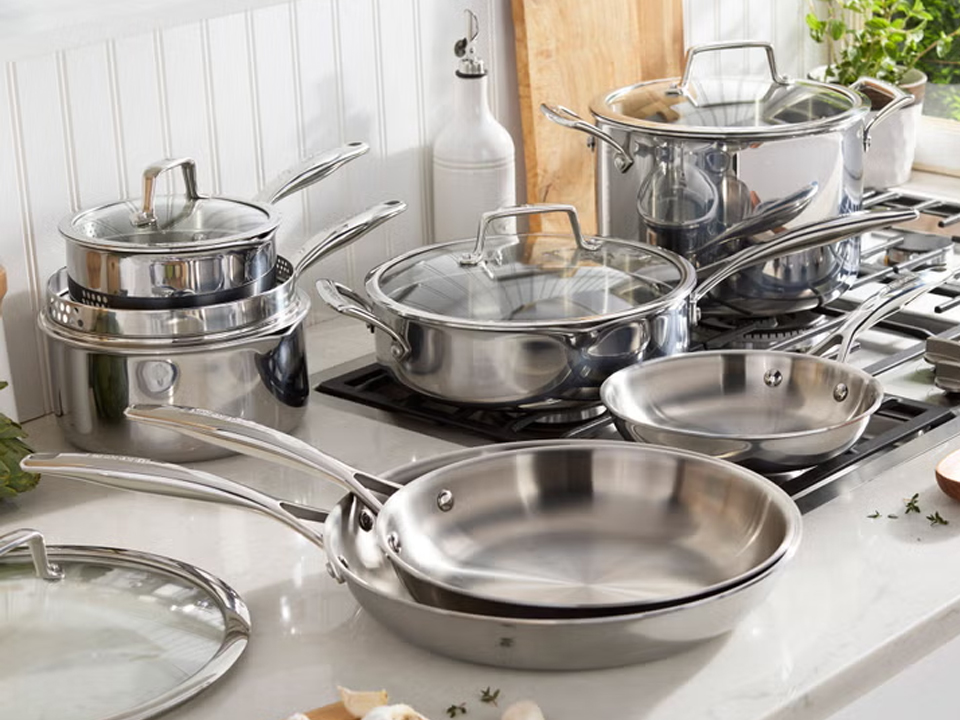
Think about three manufacturing facilities quoting a seven-piece stainless-steel cookware collection. One provides a fully clothed body, an additional makes use of an adhered induction base, and the third proposes thinner products. All 3 may satisfy an obscure request for “exceptional stainless-steel cooking equipment.”
The most affordable price may merely show a various product.
I would rather assess a higher quote with transparent presumptions than discuss versus a small cost that excludes required functions. Require suppliers to checklist variances, describe choices, and discuss their price and performance effects.
Price Is Not the Same as Value
Ask suppliers to different manufacturing expenses, packaging, personalization, tooling, testing, and delivery costs. Confirm the exact delivery term and recognize exclusions.
An EXW quotation can not be contrasted straight with a DDP quotation without accounting for the extra logistics and import-related prices.
The actual question is not which vendor provides the lowest factory price. It is which compliant provider uses the most affordable defensible total price for the defined item.
Step 1: Define the Kitchenware Item Prior To Calling Providers
Beginning with the product, not the manufacturing facility.
A producer must be able to interpret the requirements without relying on pictures or casual messages.
Define the Establish Configuration
Do not describe a product just as a “seven-piece collection.” Vendors might count lids, devices, and kitchenware bodies in different ways.
List each part separately, including its size, ability, dimensions, weight array, material, deal with type, and lid arrangement. Specify whether sizes refer to the interior, outside, or rim dimension.
For product-configuration recommendations, compare a 7-piece stainless-steel pots and pans established for wholesale supply with a 7-piece tri-ply stainless steel cooking equipment collection. Verify all technological information directly with the vendor before using them in your RFQ.
Define Building And Construction, Not Simply Product Names
“Stainless-steel” is not a total requirements.
Identify the called for grade for each appropriate component, such as AISI 304 or AISI 430 where practically proper. Specify body thickness, layer arrangement, base building and construction, surface finish, handle accessory, and lid products.
For tri-ply pots and pans, demand the layer sequence and densities. A bonded induction base is not automatically comparable to a fully clothed body.
Avoid arbitrary thickness requirements based solely on rival cases. Establish quantifiable specs that fit your item’s designated performance, price factor, and target audience.
Action 2: Transform Product Claims Into Verifiable Demands
A supplier declaration is a starting point, not proof that every production set matches the requirements.
Structure the RFQ around 3 aspects: the buyer’s requirement, the vendor’s stated specification, and the evidence required for approval.
RFQ thing
Purchaser requirement
Supplier proof
Stainless-steel
Specified grade
Material statement and traceability
Body density
Target and tolerance in mm
Measurement results
Split building and construction
Required layer arrangement
Technical attracting or cross-section
Induction compatibility
Defined efficiency requirements
Pertinent test results
Handles and knobs
Material and add-on demands
Element information and test evidence
Surface coating
End up and defect limitations
Authorized example
Food-contact safety
Appropriate market demands
Appropriate reports and statements
Packaging
Art work and protection requirements
Product packaging spec
Define tolerances for important dimensions prior to sample approval. The dimension method and appropriate limitations need to be documented for dimensions, body thickness, base monotony, and take care of placement.
Not every element needs identical tolerances. Demands need to mirror the manufacturing procedure and the product’s meant use.
Action 3: Build Food-Contact Compliance Into the RFQ
Compliance can not be reduced to a logo design on a certification.
The destination market establishes the suitable rules. Purchasers selling in the European Union must think about Policy (EC) No 1935/2004 and Excellent Production Practice requirements under Law (EC) No 2023/2006. The European Commission’s food-contact materials assistance clarifies the governing structure.
Payment Policy (EU) 2024/3190 additionally presented constraints worrying bisphenol A (BPA) and particular other bisphenols in specified food-contact materials. Its range and transitional stipulations need to be evaluated for the real item as opposed to assumed to apply identically to every cooking equipment part. See the official regulation on EUR-Lex.
For US-bound kitchenware, FDA communications in December 2024 raised concerns about lead leaching from certain imported pots and pans made from aluminum, brass, and related alloys marketed under names consisting of Hindalium and Indalium. The lesson is simple: verify products and relevant risks rather than depending on common safety and security cases.
Require suppliers to supply:
Suitable compliance statements and supporting records.
Identification of food-contact products and coverings.
Examination days, research laboratory details, and the exact version evaluated.
Limitations on designated usage, where pertinent.
Written notification of changes to products or manufacturing procedures.
A record for one version must not instantly be thought to cover every SKU.
Spinning syntax invalid. With this action you should provide text with existing valid {first option|second option} spintax.
The Bottom Line
A specialist private-label cooking equipment RFQ links item style, distributor choice, quality assurance, compliance, and commercial accountability.
The best RFQs leave little space for ambiguity while permitting providers to propose recorded alternatives. They help purchasers distinguish a truly affordable maker from one whose reduced quotation relies on missing out on specs or unverified claims.
You can not negotiate your escape of a requirements you never ever defined.
Begin with one representative SKU, develop its technological and business needs, and test your RFQ with a tiny team of competent suppliers. Refine the paper before expanding it throughout your item range. The objective is not simply to collect prices; it is to make a defensible vendor choice.